Pages

Friday, June 12, 2009

Scareware… the Next Internet Ripoff

From spyware to bots to viruses and other unimaginable hazards… the web can be a scary place.  FakeAlertAAHAs far back as Prodigy in the early days of the online world, scams have been a part of the party.  The Internet is simply a new way for the bad guys to rip off unsuspecting consumers.  The key difference though is that the reach is enormous and the damage can spread to more people, more quickly than ever before.
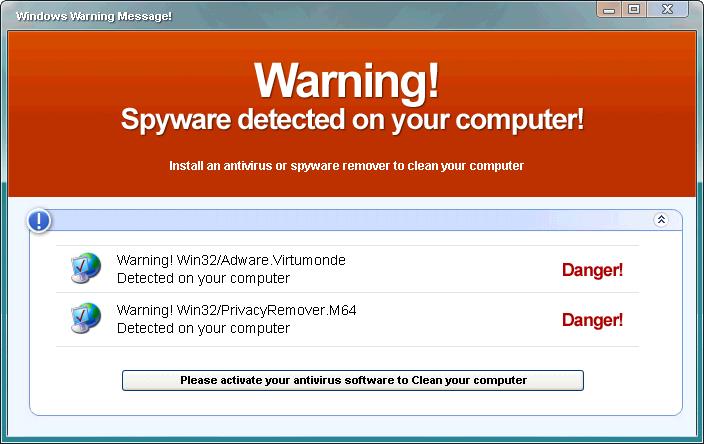

Enter scareware, new way to trick unsuspecting consumers into parting with their money.  USA Today recently had an article about the tricks and tactics used to perpetrate this latest rip off.  Unfortunately, online advertising has become an accomplice to the crime.


Scareware is worthless software that allegedly removes viruses from your computer.  Anyone who has surfed the web knows how easy it can be to become infected with a virus.  The damage to the users computer is often measured in slowed performance, unwanted clicking and potentially even more nefarious things like key logging and password swiping.  Now, the bad guys are selling “scareware” to solve a problem that may not actually exist.


The first such program was called “SpySheriff,” built by a team of cyber crooks from Russia.  The Anti-Phishing Working Group recently reported that scareware infections rose 48% in the second half of 2008.  The growth is tied to the ease of distribution and weaknesses in online advertising and the web in general.


There are several ways these fake products are being distributed.  Phony pages are created using hot search key words such as “American Idol” or “iPhone” and drive the unsuspecting consumer to the infected page.  Recently the Facebook email scam was used to send people to a page by promoting things like “best video.”  Since these emails came from your friends, millions clicked.  Twitter has become a vehicle for distribution. Phony Twitter accounts are created and enticing titles of posts encourage people to click.

Additionally, the bad guys are simply buying display or search ads.  They rotate in infected pages to the landing page.  It is virtually impossible for an ad provider to scan every ad impression and linking page.  This loophole creates an opportunity for the bad guys to drive significant traffic to infected pages at a very low cost.  Microsoft reported finding 4.4M installations of one such program, so the scale is enormous.  Do the math… at $49 or $79, that is big business.


Once someone lands on the page, getting off is nearly impossible.  Immediately upon landing, a “system scan” begins.  The results are, of course, showing that your computer is infected with a number of viruses.  Conveniently you can buy the product at that point and they take your money and run.  If you try to move away from the page, or cancel, an endless number of scans take over your screen.  Essentially, users must “control/alt/delete” their way out or restart.


The danger in this scam is not limited to monetary damage to the consumer.  These type of pages and methods to attract clicks are the same methods used to install spyware, malware and perpetrate click fraud.  To their credit, USA Today has done a good job over the last few years of highlighting the dangers of the web to the average consumer.


The FTC is cracking down.  They have identified products like WinFixer, DriveCleaner and XP AntiVirus as worthless and they are going after the owners.  The problem is that like the click fraud crooks, these guys are in remote locations and move their servers often. Tracking them is a full time job and extremely difficult.  The search engines are trying to help as well.  bingad assuranceBing has a neat feature that highlights “at risk” url’s.  Yahoo has similar product built with McAfee.


Trust is what keeps consumers clicking on ads.  Without stepped up industry efforts from organizations, like the Anti Phishing Working Groups and others, trust could be diminished.  Like click fraud, scareware is damaging trust.  It takes a community effort to stay after the problem and build solutions to take the scare out of the internet.


Tom Cuthbert

Wednesday, June 3, 2009

Welcome Bing!

Let's face it, Google needs a competitor.  Microsoft is ready to give them a run for their money (and it's a lot of money). Bing NeedleLast night, here in Seattle, Microsoft lit up the Space Needle to celebrate the launch of Bing.  Time will tell how big an impact Bing will have in search, but history may be on the Microsoft's side.

[caption id="attachment_647" align="alignright" width="300" caption="Browser Wars"]Browser Wars[/caption]

As recently as 1997, Netscape had a 80%+ share of the browser market.  Wikipedia recalls the IE 4 release in October of '97..."The release party in San Francisco featured a ten-foot-tall letter "e" logo. Netscape employees showing up to work the following morning found that giant logo on their front lawn, with a sign attached which read "From the IE team." The message also read "We Love You."

By 2002, Microsoft had a 96% share.

As we say in the sports business, "Don't sleep on Microsoft".

[brightcove vid=25062206001&exp=1543292789&w=486&h=412]

Sure there will be lots of head to head comparisons between Google and Bing.  But so far, I'm impressed...

Wondering what Google has on their front lawn this morning :)

Tom Cuthbert

Saturday, May 30, 2009

AOL... I Finally Got One Right!

It was January of 2000 and I was in my usual Tuesday morning breakfast group with my friends at Jim's.  We spent time talking about life, family and business.  My friends Matt and Shawn were far wiser than I when it came to business and technology (successful tech entrprenuer and Harvard MBA, respectively).  I was still learning the tech space and was just months away from co-founding my first tech company.  Despite my poor track record (I had recently bought stock in Pancho's Mexican Buffet.... don't laugh!) and lack of experience, I saw this disaster coming.

From the early days of the internet, I was there. (You may remember me as 635287874@prodigy.net)  aol-logoI had an AOL account even before those CD's started showing up at the checkout line at 7-Eleven.  I didn't know much, but I did know that marrying a red hot new technology company with an old school media firm was a bad idea.  It couldn't work and it didn't work. When the AOL-Time Warner merger was announced in January 2000, the combined market capitalization was $280 billion. Today it is $28B.

saichart052909-timewarnerSo here we are, eight years and billions of dollars in lost shareholder value later.  Now what?  First of all, the spinout makes perfect sense.  It will allow Armstrong and the gang to attempt to rebuild a once proud company into something at least relevant.  It also positions AOL to be a new media company by finding creative ways to leverage the assets (audience) into profit.  I saw the plan and I think it makes sense...

Silicon Alley describes the heart of the plan as making AOL more "Google-y".  There is white space below Google.  They own a ridiculous share of the search market and someone will take away market share over the next few years.  Add to that that online advertising continues to grow while traditional media implodes and poof, you have a market opportunity.  AOL is uniquely positioned to play in this space if they fully leverage their assets including ADTECH, Platform A and others.

Remember when you went to America Online, errr... I mean AOL, to read content?  They have audience, content and connecting the dots means revenue growth.  I am pulling for them now, in 2000 I was not.  The strategy then was to try and retain the "walled garden" approach and milk dial up income for as long as possible.... bad idea.

Good luck Tim, you'll need it.  But you have a shot, and that puts you well ahead of your friends back in 2000.

Tom Cuthbert

Friday, May 15, 2009

The Buzz on Click Fraud

The New York Times ran a feature article this week on click fraud.  Why you ask?  Because, like spam, click fraud is still a big problem for advertisers. The article pointed out that as the economy tilts downward, advertisers cannot afford to waste dollars. This is a good news, bad news scenario for online advertising.


The good news is that online advertising is highly measurable.  Large advertisers that traditionally have been offline are now shifting dollars online.  This fact has contributed to online advertising continuing to grow as traditional media is in decline.


The bad news however, is that this window of opportunity is narrow.  The online advertising community must embrace measurability and enhance trust to gain share of spend from the big guys. 


There was a significant event this week that helped in that effort.  The Interactive Advertising Bureau (IAB) released from draft the Click Measurement Guidelines.  This document, three years in the making, is a great start for our community to come together around standards and enhance trust. Dozens of ad providers are busily working with third party audit firms to become accredited to the new guidelines.  Advertisers will have a way to gauge the level of commitment from ad provides when this list is made public.


Click Forensics was proud to represent advertisers in this process.  In fact, we were the only traffic quality management firm to participate and were quoted in the press release from the IAB.  Many thanks are in order for the 38 members of the working group for a job well done.


Now, we find ourselves at the beginning.  An opportunity exists to build on the foundation laid by the IAB member companies.  Click fraud is going to be a problem for a long time to come.  Progress is being made.  But in order to re-accelerate the growth of online advertising we need more than standards.  We need a community effort to work together to ensure advertisers have confidence that they get what they pay for.  Articles raise awareness, documents create a process and awareness builds urgency.  But ultimately it will take the effort of everyone in the community to get to the day where trust is commonplace and online advertising becomes the marvelous, measurable media it can be.  We look forward to continuing our efforts toward that goal.


Tom Cuthbert

Wednesday, May 6, 2009

Why the Wall St. Journal Rocks

kindlecomp4Recently, I've been griping about my local paper and newspapers in general.  The industry is in turmoil and changing rapidly.  One big change will be the way the paper will be read in the future.  Today's announcement about the Kindle DX will make it easier for people like me to eventually switch to a digital reader.  I like this idea and I cannot imagine how newspapers today, in their current form, will survive, except for one...  the Wall St. Journal.

I have been an avid Journal reader for years.  The paper has changed for the better in recent years and is setting the pace for an industry in transition.  In fact, of all major newspapers in this country, the Wall St. Journal was the only one to INCREASE paid subscribers in the last month.  While an entire industry cuts content, moves online or folds all-together how can it be that the Journal grows?  

There have been several recent changes that I believe have enhanced the reading experience, broadened appeal and made the paper more useful.  That list includes:

  • wsj-graph4Added sports coverage

  • Adjusted the physical size of the paper

  • Enhanced the paid online version

  • Launched an iPhone app

  • Produce excellent podcasts and vidcasts

  • Broadened appeal with health, tech and travel

  • Reformatted the front page for easy scanning


But beyond these enhancements, fundamentally the I enjoy the Journal for three reasons.  First, the perspective is conservative yet thoughtful.  The OpEd page is engaging and thought provoking.  The editorial page in my local paper has become predictable and mundane.  Any column worth reading was syndicated from another paper.  There are essentially no independent thinkers or interesting writers.  While I don't always agree with Peggy Noonan, Kim Strassel or William McGurn, I do respect their perspective. 

Secondly, the information I read in the Journal or hear on their podcasts is relevant to me.  Walt Mossberg and Katie Boehret are consistently exceptional with product reviews and insights.  The company coverage is great and news stories are engaging.  From travel to tech and health to book and wine reviews, it fits my lifestyle.

ed-aj106_pns030_ns_200903032043361Finally the Journal entertains me in an intelligent way.  Each day there is a story on the front page that delves into topics ranging from Bollywood to windmills.  I'm a sucker for Pepper and Salt, the funny cartoon (my recent favorite at left).  The writing style is accurate when needed and relaxed when appropriate.  I also find the podcast with Gordon Deal to be a great compliment to the paper.

So as newspaper executives across the country (and here in my hometown) are scratching their heads try to figure out why they are sinking, they should pick up a copy of the Journal.  I do... everyday.

Tom Cuthbert

Thursday, April 16, 2009

Good News… Online Will Win!

A few weeks ago I spoke at the Search Engine Strategies conference in New York. I was struck at the conference that people in our industry had their heads down. I recognize the economy is tough and that jobs can be hard to find and keep. But guess what… online advertising will win!

Like you, I have friends in traditional media. Newspapers and print in general have been hammered. Radio and outdoor is fading and television is showing signs of weakness. The dollars are shifting to online and with good reason. In my preparation for the presentation (which can be found here) I spoke to senior executives at digital agencies and leading online advertisers. While the title of my presentation was, “Measurement Matters” the focus was on change.

There is no doubt that the world of online advertising is at a crossroads. According to a recent IBM survey, over 60% of all advertisers are cutting budgets… 80% of them are trimming more than 15% of the spending. This urgency was clear in this quote from the report,

“Advertisers are aggressively shifting their spend to even more interactive, measurable formats, as providers struggle to move "beyond advertising" to new forms of communication that combine the ROI characteristics of direct marketing with the brand characteristics of traditional advertising.”


The tone I heard when speaking to advertisers and agencies was consistent… “Now more than ever, we need to be sure we get what we pay for”. Jobs are on the line, performance is not optional and measurement matters.

Where can advertisers get better value and solid analytics for performance advertising? Online of course! I’ve identified five specific attitudes that need to be addressed to fully capitalize on the shifting dollars…

1) Stand on our strengths – Online advertising is measureable, has a growing reach and new and creative ways to deliver meaningful ad impressions to consumers. These are meaningful strengths that need to be communicated.
2) Tout the targeting –Saying that television advertising can target is like saying you can tell what kind of fish are in the water from the boat. Targeting (behavioral, demographic and geographic) is a strong suit of online advertising that is unmatched in traditional advertising.
3) Get creative with compensation - Advertisers need to (and will) hold agencies feet to the fire. Agencies that embrace this and are open to new models of compensation, will win.
4) Measure, measure and measure – Performance standards, benchmarking and goals are critical for success. The good news is that online holds that as a competitive advantage over traditional media. More tools are available to help with this and insight into campaigns makes a major difference in success.
5) Look beyond the “Big Two” – Yahoo and Google hold a lot of the cards when it comes to online. However, there is a growing community of quality ad networks and publishers that can deliver strong results. I’ll talk more about how to find them in a future post.

My presentation included the chart below highlighting a SWOT (strengths, weaknesses, opportunities, threats) analysis I did on our space.

swot-online

The current economic conditions create an opportunity for those of us in the digital world. Now is not the time to complain… it is the time to aggressively promote the benefits that online holds over traditional media.

Tom Cuthbert

Friday, April 3, 2009

The Future of Newspapers

A few weeks ago I noticed that the Business section was missing form my Sunday paper.  I vented by posting a tweet and followed up by sending an email to the business editor of the paper.  After a few days I received a well written reply. It stated, 
reading-the-newspaper11Unfortunately, we have discontinued the Sunday and Monday Business sections. We are not happy about it, but at the end of the day it was an action that had to be taken for the good of the institution. I am sure you are aware that we are on the cusp of technological, cultural and generational forces that are reshaping the information landscape. Add to that the most corrosive financial environment since the Great Depression and you can see the perfect storm that has slammed into the traditional business model for the general circulation newspaper.


First of all, I appreciate him taking time to respond.  I enjoy reading actual newspapers and read several of them every day.  I recognize that the industry is changing and in deep turmoil, but it seems to me there are lots of other areas to cut besides the Business section.  Maybe I'm not a typical reader since my favorite publication is the Wall St. Journal.      

My response was, in part...

Thank you for writing me back.  I recognize the difficulties all print publications have as people change habits to online.  I have followed the Seattle PI switch with interest and you are right, it is a changing world.  I know you guys are in a tough spot.  I certainly don't have the answers.  I can tell you as a technology person in this community I rely on your paper to keep me informed.  I will also tell you that  dropping Sunday and Monday will cause me to consider my subscription.    I encourage you to think of ways to enhance the coverage, more deeply engage readers, pull in more regional information and create new ways to rebuild, not retrench.  (Twitter and other social media outlets may hold some answers)


So what is the future for papers like mine?  Henry Blodget wrote and interesting article titled, "Our Plan to Fix the New York Times".  In it he discusses several options for papers.  newspapersrip1In the end, the business model is flawed given the access to data that people have.  Blogs, micro papers and online publications are pulling readership away from print.  Classified ads are less effective than ever now that they compete with Craigslist and EBay.  Even searching for homes has moved from print to Zillow and other online sites.


At the end of the day I do believe I predicted the future correctly when I wrote, 'Future conversation with my son (circa 2034) "Really Pop?  Someone actually 'threw' a PAPER copy of the news on our driveway?  No way!".  


Too bad, but that is the direction we are heading.


Tom Cuthbert